
Opening up the Sex Ed Conversation: A retrospective on a newfound appreciation for documentaries.
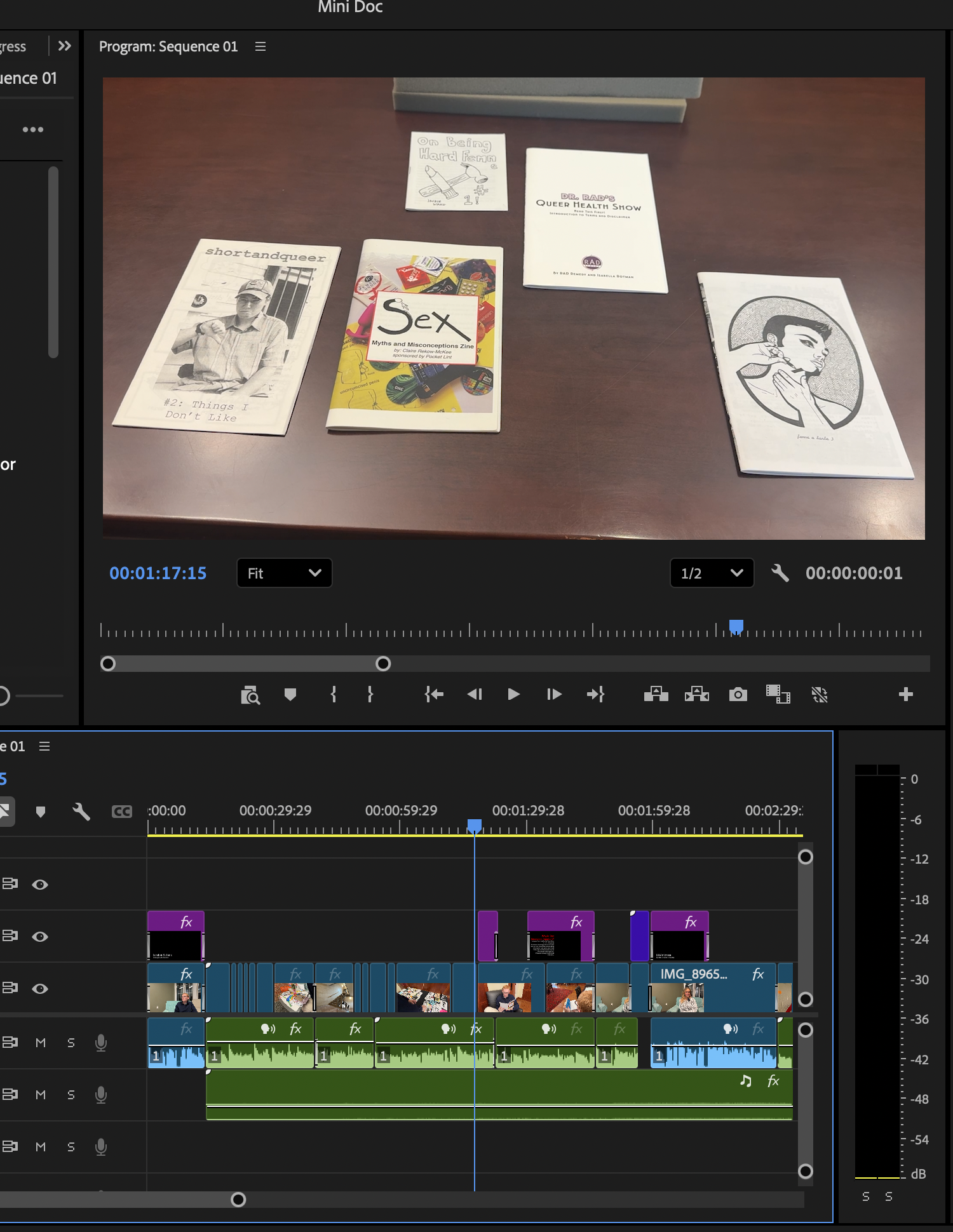
Premiere Pro timelines of the Mini Documentary, 2025.
A changemaker in the making
Through my prose, designs, and projects, I yearn to be a changemaker. Over the past month, I organized, recorded, and edited a mini-documentary on American subpar sexual education. Furman University provided a Sex-Ed in Sweden May Experience. While challenging to encapsulate in just a six-minute video, I interviewed two students, collected B-roll of them in their natural environment, and spearheaded the documentary to hold a narrative style, not only showcasing the work I did to research the topic of Sex Ed, but also to encapsulate its importance in refining the safety of the American youth. While this was challenging at times, I have grown a new appreciation for documentary-style media and the incredibly focused attention to detail it requires, as well as the overall mission to shed light on topics that might often be overlooked. Today, I possess a newfound understanding of how to enact change through my writing and videography, which I will continue to use well beyond my college career.
A Newfound Respect

Sex Education Zine, 2025.
In completing this project, I have gained a more profound respect for those who not only work on documentaries but also appear in them. In completing my project on a taboo topic rarely discussed, I knew it might feel awkward for my Interviewees, Lili Ambrose and Elizabeth Stanford, to explain their experiences with Sex Ed. I asked them to recall these challenging times, sitting in their classrooms as mere middle schoolers, listening to unqualified individuals spewing disinformation regarding “healthy” sexual practices. While I did explain that they could choose not to answer, their candor and respectful demeanor throughout this project were extremely admirable, and I have walked away with a deeper appreciation for interviewees who have to open up about personal topics.
Utilizing AI for Time Management
While working on the project, I used Adobe’s AI tool to generate transcripts for my interviews. This was extremely helpful for time management on my project, as each interview was about 20 to 30 minutes of straight dialogue, which, if self-transcribed, could have taken me multiple hours. Premiere Pro is nowadays my go-to video editing software, having previously been Apple’s Final Cut Pro 11, just because of its AI integration, which can speed up projects. While the machine learning model often dropped words or inserted the wrong ones into a transcript, this required little to fix, as I would reference the transcript only to capture timestamps and drop sound bites into my timeline.
Bringing Light to the Important Topics
Now that I have just one month until my documentary class, I will use my newfound appreciation for documentary stories to give more credit to the interviewees, rather than simply glossing over their experiences with a simple “Special Thanks.” I will continue to use introspection in finding ways storytellers connect their audio to their video and create sequences in doing so throughout their entire documentary. These soft communication skills not only make me more media-literate, but they also give credit to the millions of storytellers and their interviewees who take time to shed light on stories that enrich conversations across our globe.
sources & references
https://www.furman.edu/ https://catalog.furman.edu/preview_course_nopop.php?catoid=20&coid=40899
https://www.linkedin.com/in/lilian-ambrose-a001b937a
https://linkedin.com/in/elizabeth-stanford
https://www.adobe.com/ai/overview.html
https://www.adobe.com/products/premiere.html
https://www.apple.com/final-cut-pro/
https://catalog.furman.edu/preview_course_nopop.php?catoid=27&coid=60291
